
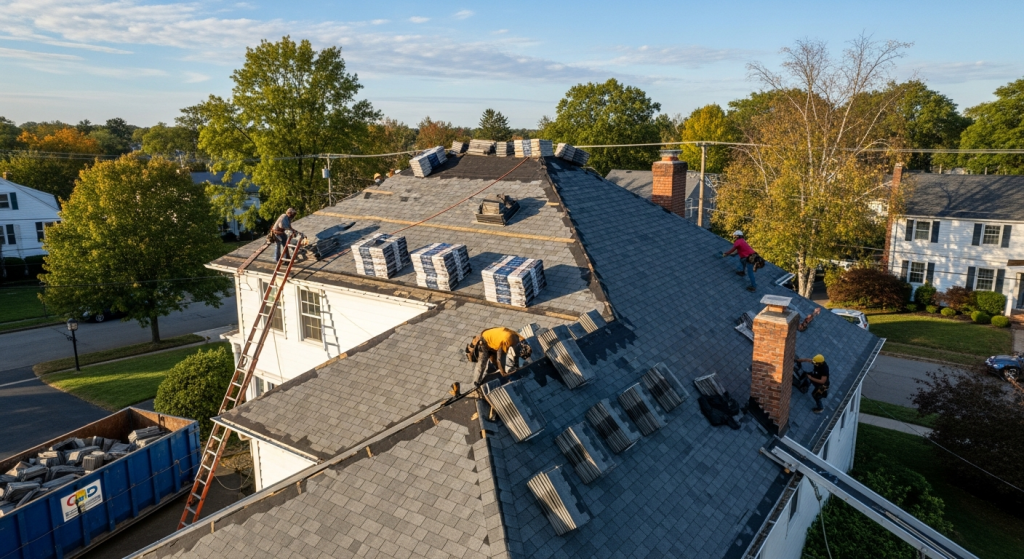
Fort Lee’s high-rise density gets most of the attention, but the borough has substantial single-family and townhouse residential stock east of Palisade Avenue. Historic homes near Fort Lee Historic Park, postwar residential neighborhoods, and newer townhouse developments all sit under the same specific Fort Lee conditions: Palisades cliffside exposure, GWB corridor wind and debris factors, and Hudson-facing weather patterns that inland Bergen towns don’t see.
Here’s the local homeowner’s guide for roofing, gutter, and siding work in Fort Lee’s residential neighborhoods — what’s specific to Palisades-adjacent homes, what to check, and how to work with Fort Lee’s borough process. From a licensed New Jersey general contractor that runs residential structural work across Fort Lee and the rest of Bergen County.
What Makes Fort Lee Residential Different
- Palisades cliffside exposure. Homes on or near the Palisades face real wind loads. Roof, gutter, and siding wear is more intense here than inland Bergen — especially on the west-facing (Hudson-facing) side of any home.
- Hudson River salt haze. Even though Fort Lee isn’t oceanfront, prevailing wind patterns push Hudson salt onto exterior surfaces. Different corrosion patterns than inland Bergen — especially on metal roofing, aluminum gutters, and metal flashing.
- GWB corridor traffic and exhaust. Homes near the GWB approach face diesel exhaust and airborne debris that inland Bergen towns don’t. Impact on roof surfaces, gutter debris load, and siding staining over decades.
- Windborne debris. The GWB corridor concentrates wind-driven debris during storm events. Real risk to roof structures and windows.
- Mixed housing generations. Historic homes near Fort Lee Historic Park, established postwar neighborhoods, and newer townhouse developments — different structural exterior needs per generation.
- Fort Lee borough permit process. Specific procedures — the borough construction office is a real municipal function separate from surrounding Bergen boroughs.
The Borough of Fort Lee website covers construction office contacts and permit requirements.
Fort Lee’s Housing Generations
Historic Fort Lee (Pre-1930s)
- Older homes near Fort Lee Historic Park and along the historic core
- Original slate or clay tile roofs on some properties
- Copper flashing on some historic homes
- Wooden clapboard or wooden shake siding
- Character preservation considerations for exterior work
Postwar Residential (1940s–1970s)
- Bulk of Fort Lee residential stock east of Palisade Avenue
- Original roofs long since replaced; second and third generation roofs common
- Original gutters gone; 1990s and 2000s replacements now aging
- Aluminum siding from 1970s-80s; vinyl siding from 1990s-2000s
- Aging chimney flashing patterns similar to other postwar Bergen towns
Same aging pattern applies as Paramus and Hackensack — our Paramus roofing guide covers the postwar aging story in detail.
Townhouse and Newer Construction
- Attached townhouse developments (mainly 1980s-present)
- Party wall considerations for roof and siding work
- HOA governance on many townhouse properties — affects vendor selection, timing, materials
- Newer materials — architectural asphalt shingles, aluminum or PVC gutters, fiber cement siding
- Modern flashing and drainage systems
Palisades and GWB-Corridor Specific Considerations
- West-facing surfaces take the worst weather. Roofing shingle wear, siding damage, and gutter stress are all concentrated on the Hudson-facing side of homes.
- Wind-driven rain infiltration. Standard flashing and weep hole configurations may not be adequate for Palisades wind loads. Specialty flashing at west-facing dormers, windows, and doors matters.
- Salt corrosion on metal components. Aluminum gutters, metal roof panels, metal flashing, and steel window frames corrode faster near the Palisades. Material selection matters more here than inland.
- Cliffside foundation drainage. Homes on or adjacent to cliff faces have unique drainage patterns. Gutter downspout routing matters more here for foundation health.
- Windborne debris impact. Storm events send more debris (branches, roof material, construction debris) into west-facing surfaces. Real roof impact risk during major storms.
- Higher storm frequency and intensity. Hudson-corridor storms hit Fort Lee harder than most inland Bergen towns.
What to Check on Your Fort Lee Home This Year
Roof
- Age of current roofing system (installation date)
- West-facing slope wear (usually worst on Fort Lee homes)
- Roof valleys, ridge cap, chimney flashing
- Any daylight visible from the attic through the deck
- Wet insulation or staining in attic spaces
- Metal flashing corrosion (salt exposure)
Our post on 5 signs your roof needs replacement covers general diagnostic.
Gutters
- Material — aluminum, copper (historic), galvanized
- Salt corrosion patterns (Fort Lee-specific consideration)
- Age and condition
- Downspout function (run a hose to test)
- Splash blocks and foundation drainage adequate for Palisades-adjacent property
- Wind damage or storm displacement from GWB corridor exposure
Siding
- Material — wood (historic), aluminum, vinyl, fiber cement
- West-facing surfaces show wear first
- Impact damage from windborne debris
- Windborne moisture penetration around windows and doors
- Trim, corners, water tables — transition points fail first under Palisades conditions
Our post on when siding needs replacement walks through material-specific criteria.
Townhouse-Specific Considerations
Fort Lee townhouse residents have additional considerations that single-family homeowners don’t:
- Party wall coordination. Roof, siding, and gutter work often spans multiple attached units. HOA coordination or neighbor coordination required.
- HOA governance. Many Fort Lee townhouse communities have HOAs that govern exterior materials, vendor selection, and work scheduling.
- Reserve fund vs. individual homeowner responsibility. Some scope items (roof, exterior siding, gutters) may be HOA-scope; others individual. Check declaration before assuming.
- Matching consistency across attached units. Even when work is homeowner-responsibility, matching adjacent units affects HOA appearance standards.
If Storm Damage Started the Conversation
Fort Lee’s Hudson corridor exposure means storms hit Fort Lee harder than most Bergen towns. Our Bergen County storm response trilogy covers the first 48 hours:
- Roof storm damage — first 48 hours
- Gutter storm damage — first 48 hours
- Siding storm damage — first 48 hours
Fort Lee-specific consideration: Palisades-facing damage documentation is more important here than inland Bergen — insurers may scrutinize whether damage is storm-caused or gradual salt/wind wear.
The Fort Lee Storm-Chaser Warning
Fort Lee’s central Bergen location and GWB access make it a favorite target for storm-chasing contractors. Same red flags apply:
- Door-knocking within 48 hours of any storm is a red flag
- Out-of-state license plates and phone numbers are red flags
- Free-inspection sales pitches leading to same-day contracts are red flags
- Any pressure to sign an Assignment of Benefits is an automatic disqualifier
- Contractors that don’t know Fort Lee’s borough construction office are red flags
- Contractors without demonstrated Palisades-corridor experience are red flags — the specific salt corrosion and wind exposure conditions require specific expertise
The Bergen County government website provides consumer protection contacts.
Fall Prep for Fort Lee Homes
Fall is the right window for Fort Lee structural exterior work — after summer heat, before winter Hudson storms. Our Bergen County fall roof prep guide covers the seasonal checklist. Fort Lee-specific timing:
- West-facing slope inspection priority — Hudson-corridor storms concentrate here
- Salt residue rinse from metal components before winter
- Extra caulking and weathersealing at west-facing transitions
- Wind load stress inspection on gutters and downspouts
- Storm response contract confirmed for winter events
Bundling Roof, Gutter, and Siding Work
Fort Lee homes hitting the aging window on multiple systems benefit from bundling — same logic as other Bergen towns with Fort Lee-specific coordination:
- Single contractor manages Palisades-corridor material selection consistently
- Party wall coordination on townhouse work
- HOA notification and approval as needed
- One permit conversation with Fort Lee borough construction office
- Historic material sourcing if applicable (homes near Fort Lee Historic Park)
Bergen County Hub Content
- Bergen County general contracting hub
- Paramus roofing, gutters, and siding guide
- Hackensack roofing, gutters, and siding guide
- Ridgewood estate roofing guide
Local Fort Lee Structural Exterior Response
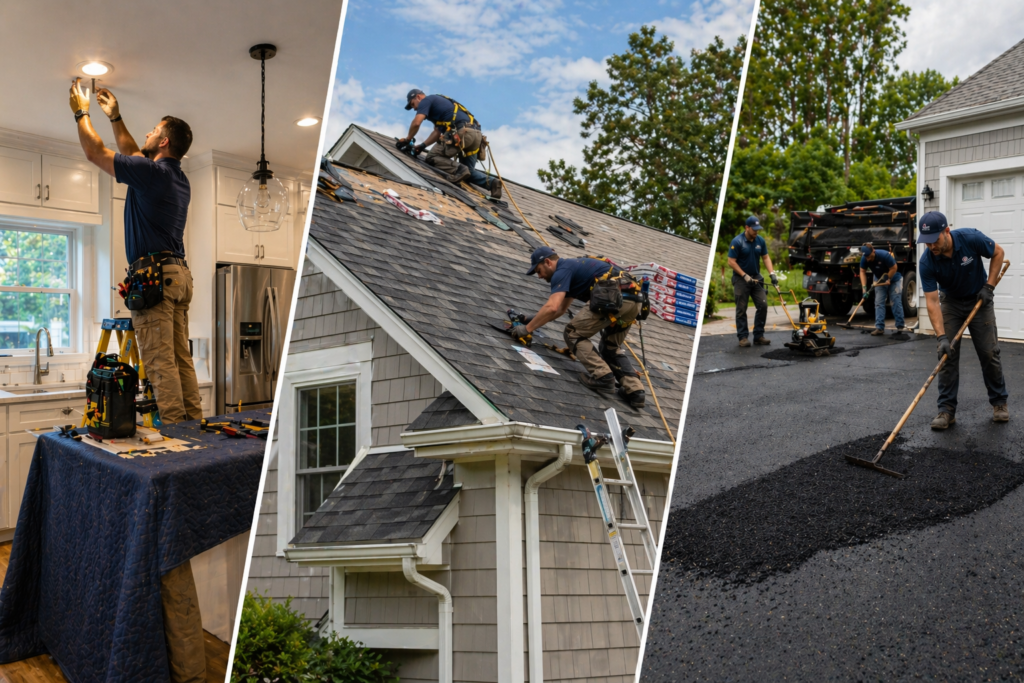
If you own a single-family or townhouse home in Fort Lee and need a real evaluation on roofing, gutters, siding, or the full exterior, Nuvista runs bundled residential structural work across Fort Lee, the rest of Bergen County, and surrounding counties. We’re a licensed New Jersey general contractor with real insurance, real Bergen-area presence, and Palisades-corridor experience — including the specific salt exposure and wind load considerations that Fort Lee homes face.
We handle residential roofing, gutter installation and replacement, and siding installation as bundled scope when it makes sense.